Does paintball burn calories? Yes, paintball burns roughly 350 to 600 calories per hour for a typical recreational player, which puts it on par with hiking, casual cycling, or playing tennis. Tournament speedball can push burn rates above 700 calories per hour because of the constant sprinting, sliding, and snap shooting. Actual numbers depend on body weight, intensity, and game format.
For a deeper look at training for the sport, see paintball fitness and paintball training drills.
Calorie Burn by Activity
Estimates assume a 175-pound (80 kg) adult playing for one full hour. Lighter players burn proportionally less, heavier players proportionally more.
| Activity | Calories per Hour |
|---|---|
| Recreational woodsball (walking pace) | 350–450 |
| Recreational speedball (rec field) | 450–600 |
| Tournament speedball (NXL pace) | 600–750+ |
| Magfed scenario play | 400–550 |
| Walking (3 mph) | 280 |
| Hiking | 430 |
| Casual cycling (10 mph) | 470 |
| Tennis (singles) | 580 |
| Basketball (full court) | 580 |
| Soccer (recreational) | 600 |
| Running (5 mph) | 670 |
Why Paintball Burns More Than People Expect
Paintball does not look like cardio when you watch a game from outside. Players spend most of their time crouched behind bunkers and not moving. The calorie burn comes from what happens between those static moments:
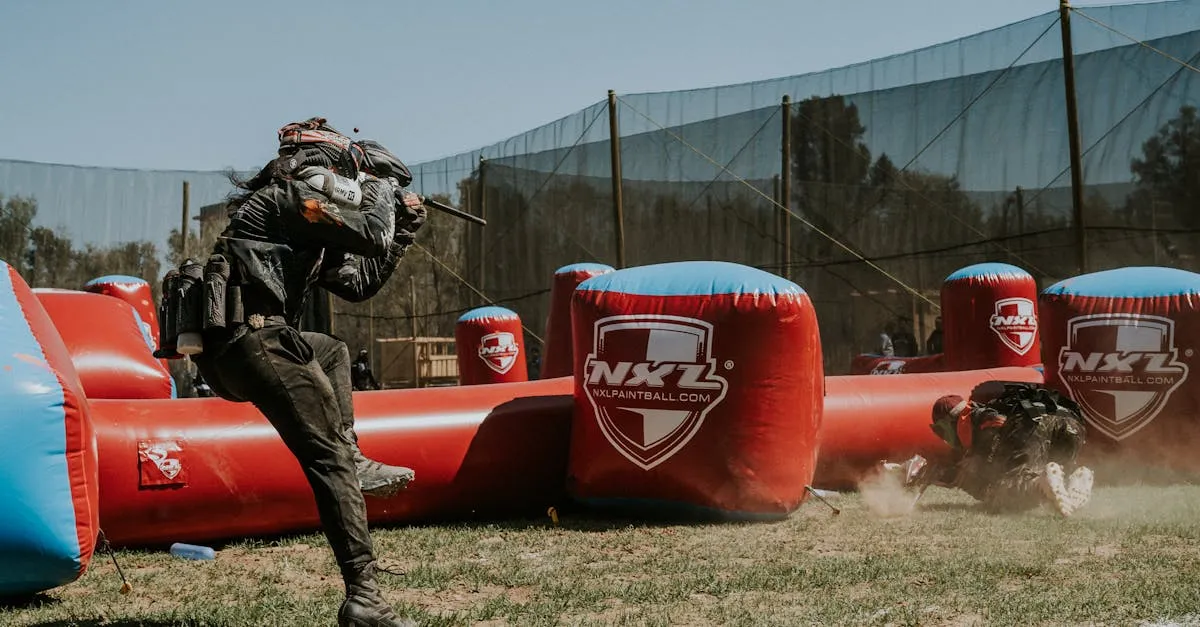
- Sprints between bunkers. Each bunker move is a 5–15 yard all-out sprint, repeated 20–40 times per game.
- Snap shooting. Pushing out from a bunker, firing, and pulling back engages the whole core and legs in short bursts.
- Slides and dives. Aggressive players slide into bunkers, which burns calories the way diving plays burn calories in volleyball or baseball.
- Carrying gear. A loaded paintball setup weighs 8–15 pounds (marker, hopper, tank, pods, harness). Walking with that for hours burns more than walking unloaded.
- Anaerobic recovery. The intervals between sprints raise your heart rate and keep it elevated, similar to HIIT training.
The pattern is closer to interval training than steady-state cardio, which is why a single hour of speedball can burn as many calories as 90 minutes of light hiking.
What Affects Your Calorie Burn
| Factor | Effect on Calorie Burn |
|---|---|
| Body weight | +/- 10% per 20 lbs |
| Game format | Speedball burns 30–50% more than woodsball |
| Field size | Larger fields = more walking = more burn |
| Number of games per hour | More short games = more sprint resets |
| Gear weight | Heavier loadout = higher burn |
| Temperature | Hot weather raises heart rate and burn |
| Skill level | Beginners move less, burn less; experienced players move more |
A 130-pound player walking through a slow scenario game might burn 250 calories an hour. A 220-pound tournament player running a full speedball point might burn 850. Both are paintball.
Paintball as Fitness
Paintball is not a substitute for a structured fitness program, but it has real cardiovascular and muscular benefits:
- Interval cardio. The sprint-and-recover pattern improves anaerobic capacity and VO2 max, similar to soccer or basketball.
- Lower-body strength. Crouching, sliding, and sprinting all train the quads, hamstrings, and glutes.
- Core stability. Snap shooting from a bunker requires constant rotational core engagement.
- Reaction speed. Reading the field and responding to opponents trains reflexes that have no equivalent in steady-state cardio.
Tournament players often supplement paintball with running, weight training, and mobility work because tournament weekends are physically demanding. A typical NXL player may run 2–4 miles in cumulative sprints across a single tournament day.
How a Full Day at the Field Compares
A typical Saturday at a paintball field involves 4–6 hours of total time on site, with 2–4 hours of actual game time spread across multiple sessions. For a 175-pound player:
- 4 hours of recreational woodsball: 1,400–1,800 calories burned
- 4 hours of recreational speedball: 1,800–2,400 calories burned
- 4 hours of tournament-level play: 2,400–3,000+ calories burned
This is comparable to a half-day hike or a long bike ride, with the added benefit that the activity is interesting enough to sustain for hours without feeling like exercise.
Hydration and Calories Out
Paintball gear is hot. The mask, jersey, and pads trap heat, and players often underestimate how much fluid they lose. Plan to drink 16–32 ounces of water per hour of play. In summer or in southern fields, double that.
Players who skip hydration often feel the calorie burn as fatigue and headaches by the last games of the session. The activity itself is fine. The dehydration is what makes a long day feel punishing.
How to Increase Your Burn
If you want paintball to count as a workout:
- Play speedball over woodsball. Speedball’s short, fast points burn more per hour.
- Move every game. Aggressive play burns more than camping.
- Take fewer breaks. Back-to-back games with short rest intervals raise total burn.
- Carry a full pod pack. Extra weight increases calorie expenditure.
- Run between rounds. Walking back to staging is a missed opportunity.
Calorie Burn FAQ
How many calories does a 4-hour paintball session burn?
A 175-pound player burns roughly 1,400 to 2,400 calories in a 4-hour session, depending on whether they are playing recreational woodsball or competitive speedball. Lighter players burn less, heavier players burn more. The most active formats can push past 3,000 calories for a full day.
Is paintball a good workout?
Yes, in the same way pickup basketball or recreational soccer is a good workout. Paintball provides interval cardio, lower-body strength training, and reaction-speed work. It is not a substitute for structured fitness, but it is significantly more active than non-players assume.
Does paintball help you lose weight?
Paintball can support weight loss as part of a broader caloric deficit, but it is not efficient as a sole exercise method because most people only play once a week or less. A weekly 4-hour session burning 1,500 calories is roughly equivalent to a half-day hike. Combine paintball with regular activity for sustained weight loss.
What burns more calories: paintball or airsoft?
The two are similar because the gameplay patterns are nearly identical. Airsoft games tend to be longer and more scenario-based, which can mean lower per-hour burn but higher total burn. Speedball-style paintball burns more per hour than typical airsoft because of the higher pace.
Why am I so sore after playing paintball?
Paintball uses muscle groups that most casual exercisers do not target: deep glutes from crouching, calves from sliding, forearms from grip, and the rotational core from snap shooting. First-time players are typically sore in unusual places for a day or two. Regular players adapt within a few sessions.