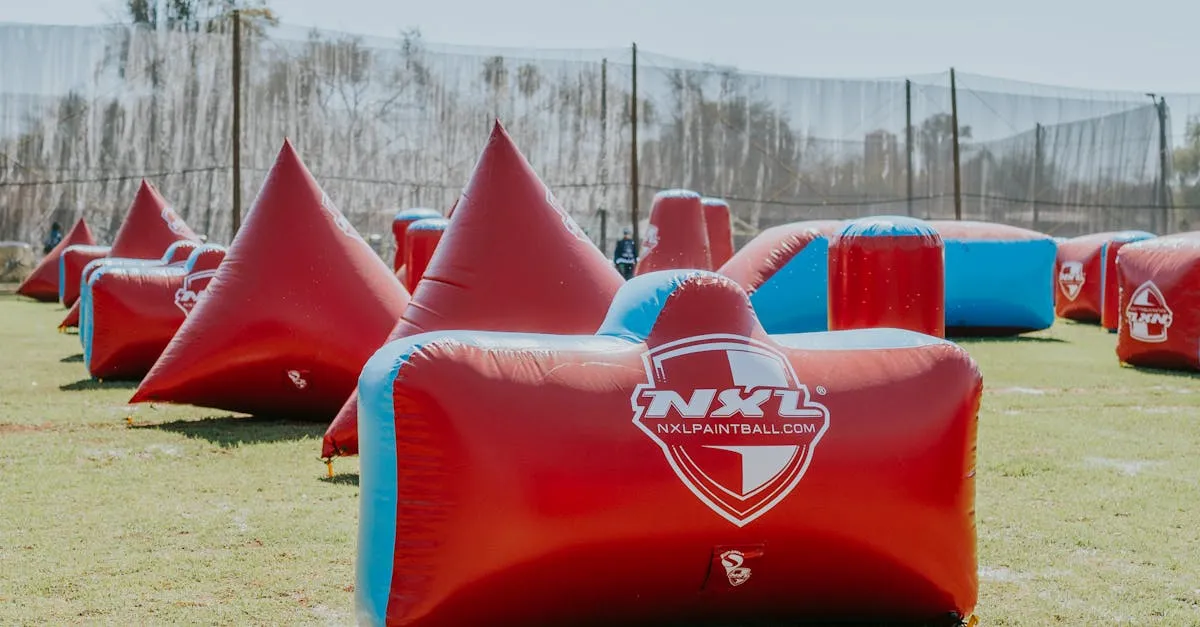
How do you play speedball? Speedball is a fast-paced paintball format played on a small, symmetrical field with inflatable bunkers where two teams of five try to eliminate all opponents or capture a center flag. Rounds last two to ten minutes, with tournament rules capping fire rates at 10.2 balls per second. Speedball rewards speed, communication, and snap shooting over stealth or positioning.
What Makes Speedball Different
Unlike woodsball or scenario games, speedball strips paintball down to its competitive core. There is no natural terrain, no hiding in the woods, and no drawn-out firefights. Two equal teams face off on a mirrored field. Most formats use five players per side, though three-on-three and seven-on-seven divisions also exist.
The symmetrical layout means neither team has a positional advantage at the start. Every advantage comes from execution: who moves faster, communicates better, and shoots more accurately. This is what draws players to speedball and separates it from other types of paintball games.
Field Layout and Bunker Types
A speedball field is built on flat ground with inflatable bunkers arranged in a mirror image from one end to the other. Knowing the bunker names is essential for communication during a game.
| Bunker | Shape | Location | Role |
|---|---|---|---|
| Snake | Low, connected segments | One sideline | Most aggressive position; players crawl through it to work angles from a low profile |
| Doritos | Tall triangles (shaped like the chip) | Opposite sideline from the snake | Standing cover with tight cross-field angles; requires strong snap shooting |
| 50s (center bunkers) | Varies | Midfield line | High-risk, high-reward; controls lanes in multiple directions |
| Cans | Tall cylinders | Scattered throughout | Stepping stones between start and primary bunkers |
| Stands (bricks) | Upright rectangles | Scattered throughout | Secondary positions and crossfire opportunities |
Every field layout is different, but these bunker types appear in virtually every competitive speedball configuration. For a full list of field callouts and positions, see our paintball glossary. Tournament organizations like the NXL publish field layouts before events so teams can practice on the exact setup they will face.
Player Positions
Speedball teams assign players to positions based on their role during each point. For a deeper dive, see our dedicated guide to paintball positions.
- Front players sprint off the break to grab aggressive bunkers on the snake or dorito side. They need speed, low-profile movement, and the ability to make eliminations up close. Fronts shoot less paint than other positions because they rely on movement rather than volume.
- Mid players push to secondary bunkers off the break, provide crossfire support for the fronts, and bump up (advance) when an opponent is eliminated. A good mid player reads the game and adapts, sometimes playing aggressively, sometimes holding a lane.
- Back players stay near the starting position and lay down heavy fire off the break. Their primary job is shooting lanes: sending streams of paint down specific corridors to prevent opponents from reaching their bunkers. Backs also call out opponent positions and direct movement since they have the widest view of the field.
Speedball Rules
Speedball follows a standard set of rules across most leagues and fields:
- Team size: Five players per side in standard NXL format (3v3 and 7v7 divisions also exist)
- Game start: Both teams begin at opposite ends of the field. A horn or whistle signals the break
- Elimination: A player is out when a paintball breaks and leaves a visible mark anywhere on the body or gear. Paint splatter from a nearby hit does not count
- Surrenders and barrel tags: Not used in competitive speedball. You shoot to eliminate regardless of distance
- Rate of fire cap: 10.2 balls per second (BPS) in NXL ramping mode. Semi-auto and PSP ramping are common at local fields
- Time limit: Points typically run two to five minutes. If time expires, the team with more surviving players wins the point
- Flag format: Some formats use center-flag pull (grab the flag and hang it on the opponent’s start station). Others use elimination-only scoring
- Penalties: Playing on (continuing to play after being hit), wiping paint, and overshooting (excessive hits on an eliminated player) all result in penalties ranging from one-for-one pulls to full team ejections
- Chronograph: All markers must shoot under 300 FPS (most fields enforce 280 FPS). Markers are spot-checked between points
For the full rulebook on professional paintball leagues and tournament formats, check the NXL official rules. Recreational fields may adjust time limits and team sizes but follow the same core rules.
Basic Strategy
Lanes
A lane is a stream of paint directed at a specific path on the field. Off the break (the initial sprint when the game starts), back players shoot lanes to tag opponents running to their bunkers. Effective laning wins points before the real gunfight even begins.
Bumping
Bumping means advancing from one bunker to a more aggressive one. You bump when your team gets an elimination and creates a numbers advantage. The key is timing: move too early and you run into paint, move too late and you waste the advantage.
Crossups
A crossup happens when two players on opposite sides of the field coordinate to shoot the same opponent from different angles. One player pins an opponent on one side of a bunker while a teammate on the far side shoots the exposed side. Crossups are one of the most effective ways to eliminate entrenched players.
Playing the Numbers
When your team gets an elimination, you have a numbers advantage. Push it aggressively before the other team can adjust. If your team loses a player, the remaining players tighten up and play conservatively until they can even things out.
Gear You Need
| Gear | What to look for | Why it matters |
|---|---|---|
| Marker | Electronic, high rate of fire, consistent | Needs to fire thousands of shots in a single day; see the best speedball guns |
| Hopper | Force-fed electronic, 10+ bps feed rate | Gravity hoppers cannot keep up with electronic markers |
| Tank | Carbon fiber HPA (68/4500 or 77/4500) | Lighter than steel, holds more air for high-volume shooting |
| Mask | Dual-pane thermal lens | Prevents fogging during intense play; invest here first |
| Pod pack | 4-6 pod harness | Your hopper alone will not last a full point; see the best pods and harnesses |
| Jersey and pants | Padded, sport-specific | Protects against hits and allows diving, sliding, and crawling; see the best paintball jerseys |
| Footwear | Cleats or turf shoes | Traction on grass or turf fields |
Paint Consumption
Speedball eats paint. Here is what to expect:
- Practice session: one full case (2,000 rounds) per player, sometimes more
- Tournament day: two to four cases per player depending on format
Paint is the single biggest recurring cost in competitive paintball. Many teams buy in bulk or negotiate with fields and sponsors to manage the expense.
Getting Into Competitive Play
- Attend local speedball nights. Most fields with an airball or hyperball setup host regular sessions where walk-on players can join experienced teams for drills and scrimmages.
- Find or form a team. Look for players at your skill level. Regional leagues and divisional tournaments offer entry-level divisions (D5 or D4 in NXL format) designed for new competitive teams.
- Drill your breakouts. Practice structure matters more than raw talent at the lower divisions. Teams that drill breakouts, practice game plans for each layout, and develop consistent communication outperform teams with better individual players but no coordination.
The jump from recreational speedball to competitive play is one of the most rewarding steps you can take in paintball. The community is welcoming to new teams, and divisional play means you face opponents at your own level while you develop.