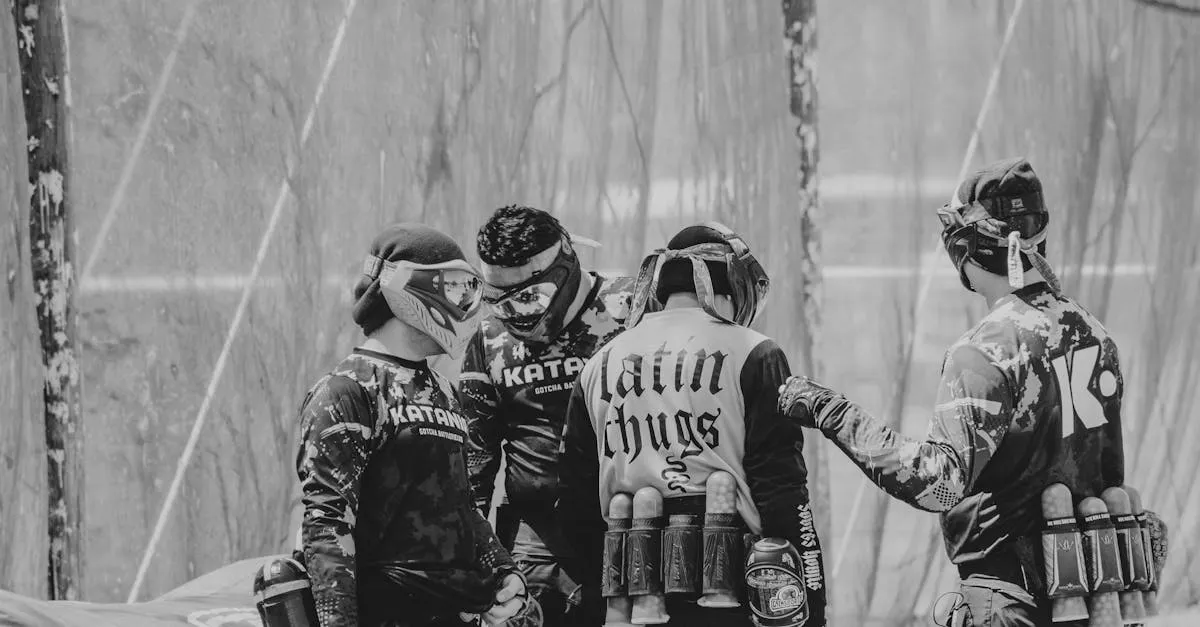
What hand signals do paintball players use? Paintball teams use a small set of standardized hand signals to communicate silently during play. The most common are pointing for enemy direction, fingers held up to indicate enemy count, a flat palm for “hold” or “wait,” a fist pump or rolling motion for “move,” and a thumb across the throat or finger to lips for “they cannot hear me, talk normally” or “stay quiet.” Hand signals are critical in woodsball and scenario play where opponents listen for voice calls.
For verbal team communication, see paintball communication.
Why Hand Signals Matter
Verbal callouts work great in speedball where bunkers are close together and field noise is constant. They work poorly in woodsball, scenario, and magfed play where:
- Sound travels through trees and reveals position
- Opponents are listening for the same callouts you are using
- Distance between teammates makes voice impractical
- Stealth is part of the gameplay
Hand signals let you coordinate movement, call out threats, and confirm ammo status without giving away your position or your plan.
Core Hand Signals
| Signal | Meaning | When to Use |
|---|---|---|
| Point with index finger | Enemy this direction | Calling out an opponent’s position |
| Fingers up (1, 2, 3…) | Number of enemies | Enemy count after spotting |
| Flat palm forward | Hold position | Stop, wait, do not advance |
| Fist pump or rolling motion | Move/advance | Cue teammate to push forward |
| Open hand on chest | Cover me | Asking for suppressing fire |
| Thumb across throat | Eliminated/dead | Calling yourself or someone else out |
| Tap on head | Acknowledged/copy | Confirming receipt of a signal |
| Finger to lips | Quiet | Stop talking, listen, stealth mode |
| Cup hand to ear | Listen | Pointing out enemy noise |
| Two fingers to eyes | I see them | Visual confirmation |
| Crossed wrists | Can’t move/pinned | Calling for help, stuck |
| Pointing at watch | Time/clock | Asking how much game time is left |
Combat Signals
These cover positioning and tactical decisions:
- Pointing at a bunker, then at yourself. “I’ll take that bunker.”
- Pointing at a teammate, then at a bunker. “You take that bunker.”
- Two fingers walking on palm. “Flanking” or “moving around.”
- Slashing motion across the body. “Cut off this lane” or “block this angle.”
- Hand drawing a circle. “Loop around” or “circle.”
- Open palm sweeping low to high. “Push up” or “advance now.”
- Open palm sweeping high to low. “Get down” or “stay low.”
Ammo and Air Signals
Mid-game status without breaking stealth:
- Tap on hopper. “I have paint” or “checking paint.”
- Empty fist pump. “I’m out of paint” or “low on paint.”
- Tap on tank. “Air check” or “I have air.”
- Two thumbs up after a tank check. “I have plenty.”
- Closed fist after a tank check. “Almost out.”
These matter in scenario and magfed play where players carry limited paint and need to coordinate resupply.
Direction and Distance
- Point with full arm. Specific direction, especially over distance.
- Two fingers held up at eye level then pointed. “Look there” to draw a teammate’s eye.
- Fingers to indicate distance. Some teams use 1, 2, 3 fingers for “close,” “medium,” “far,” but this varies.
- Hand sweeping across an arc. “Enemies along this line” or “scan this area.”
Speedball-Specific Signals
Tournament speedball uses voice almost exclusively because the field is small and verbal callouts are faster. The few hand signals that survive in speedball:
- Pointing at a bunker. “I’m running there next” or “they’re behind that one.”
- Closed fist. “Hold” used between points or while regrouping.
- Open hand sweep. “Coordinated push now.”
In a 5-minute speedball point, players rely on their teammates’ voices for almost all information. Hand signals come into play during the dead time between points, not during active play.
Woodsball and Scenario Signals
Woodsball and scenario play use hand signals constantly. Common patterns:
- Movement coordination. Squad leader uses signals to direct teammates left, right, advance, hold, retreat.
- Enemy spotting. Point first, then use fingers to indicate count, then use direction signals to refine location.
- Stealth approach. Finger to lips to signal silence, then hand signals for the entire approach until contact is made.
- Resupply calls. Empty fist or tap on hopper to coordinate paint sharing.
Players in scenario games often develop team-specific signals on top of the standard set. Signals for “regroup at base,” “follow me,” or “fire in the hole” become useful during longer engagements.
How to Practice Hand Signals
- Agree on the set with your team. Most teams use the standard signals above plus 2–4 custom ones. Write them down or review before games.
- Use them in scrimmages. Hand signals only work if everyone on the team knows them and uses them. Voice habits are hard to break.
- Pair with voice during practice. Use both during early practice. The signal reinforces the verbal call until everyone learns the silent version.
- Test stealth scenarios. Run a few woodsball games where verbal calls are banned. This forces signal use and exposes weak spots.
For more on team coordination, see paintball communication, paintball positions, and paintball strategy and tactics.
Common Mistakes
| Mistake | Why It Fails |
|---|---|
| Using complex multi-step signals | Teammates miss part of the signal under stress |
| Sending signals teammates do not see | A signal pointed away from your team is useless |
| Mixing voice and hand signals inconsistently | Confuses teammates about which is the real call |
| Forgetting to confirm receipt | Sender does not know the signal landed |
| Inventing signals on the fly | Teammates do not understand new signals mid-game |
The fix for all five is the same: agree on a small set of signals before the game and stick to them.
Paintball Hand Signals FAQ
Are paintball hand signals the same as military hand signals?
Many overlap because tactical paintball borrows from military and law enforcement signals. Pointing for direction, fingers up for enemy count, and flat palm for hold are common to both. Paintball-specific signals like tapping a hopper for paint check or thumb across throat for elimination are paintball-only adaptations.
When do you use hand signals in paintball?
Hand signals are most common in woodsball, scenario, and magfed play where stealth and distance make voice calls impractical or risky. Speedball relies on voice almost exclusively because the field is small and fast. Hand signals also work for between-point regrouping and pre-game tactical planning.
What is the most important paintball hand signal?
Pointing for enemy direction is the single most useful signal because it lets a teammate engage without you having to speak. After that, fingers up for enemy count and flat palm for hold are the two most-used signals in scenario play.
How do you signal you are out of paint?
The most common signal is an empty fist pump, sometimes paired with tapping on the hopper to indicate the issue is paint, not air. Some teams use a specific gesture like crossing arms over the hopper to mean “completely out, need resupply now.”
Can paintball referees use hand signals?
Yes. Paintball referees use a standardized set of hand signals to call eliminations (pointing at the eliminated player and saying “out”), penalties (specific signals for major and minor penalties in tournament play), and game state (hand on top of the head for “neutral” or “stop”). These are referee-specific and separate from team communication signals.